9. Measuring streaming ASR
What you will learn
- How word and character error rates are computed, why they can exceed 100%, and why every one of them needs the text normalizer that produced it.
- The extra numbers a streaming recognizer needs beyond accuracy: partial stability, first-token delay, final latency and real-time factor, and how to measure them without a microphone.
- How to read published streaming results: which decoding pass, which chunk convention, which test set.
- The book's own measurements of both tracks, in English and Mandarin, on one CPU and one RTX 4090.
Before you start
- Chapters: 3 (latency vocabulary), 5 (chunk conventions), 6 (partial and final results).
- Tools: the
ssh-asrenvironment for the CPU track,ssh-nemoand a GPU for the GPU track (code/README.md).
Word error rate, counted by hand
A recognizer's output is compared with a reference transcript by aligning them word by word with the fewest edits. Each edit is a substitution (S, a wrong word), a deletion (D, a missing word) or an insertion (I, an extra word). The word error rate is
WER = (S + D + I) / N,
where N is the number of words in the reference. jiwer, the Python scorer used here, computes exactly
wer = float(S + D + I) / float(H + S + D), H being the correctly recognized words
(jiwer process.py, line 247).
NIST's sclite, the reference scorer of the field, divides every error type by the number of reference
words in the same way.
An example. Reference: "the cat sat on the mat", 6 words. Hypothesis: "the cat sit on mat now".
| Reference | the | cat | sat | on | the | mat | |
|---|---|---|---|---|---|---|---|
| Hypothesis | the | cat | sit | on | mat | now | |
| Edit | S | D | I |
Three edits over six reference words: WER = 3/6 = 50%. Because insertions have no limit, WER can exceed 100%: reference "hello", hypothesis "oh hello there friend" has three insertions, a WER of 300%.
For a test set, add the edits of all utterances and divide by all reference words. This pooled WER weights each utterance by its length. Some evaluation scripts average the per-utterance WERs instead, which lets a two-word utterance count as much as a fifty-word one. The book always pools, and so should you; check which one a published number used.
Character error rate (CER) is the same computation over characters. It is the standard for Mandarin, which has no spaces between words. Reference 今天天气很好 (6 characters), hypothesis 今天天汽好吗: 气 → 汽 is a substitution, 很 is deleted, 吗 is inserted. CER = 3/6 = 50%.
The normalizer is part of the number
"Mr. Smith's 2 cats." and "mister smiths two cats" are the same speech. Scored as raw strings they share no word. Before scoring, both the reference and the hypothesis go through a text normalizer, and the choice of normalizer can move WER by more than the difference between two models.
Whisper's paper states the goal: "a best-effort attempt to penalize only when a word error is caused by
actually mistranscribing a word, and not by formatting or punctuation differences"
(arXiv:2212.04356, Appendix C). Its English normalizer, in order
(whisper/normalizers/english.py, lines 526-550):
lowercase; remove text in brackets; remove fillers (hmm, mm, mhm, mmm, uh, um); expand contractions and
titles ("won't" → "will not", "mr" → "mister"); remove symbols except .%$¢€£; write numbers as digits;
map British to American spelling; collapse whitespace. The Open ASR Leaderboard uses a normalizer
"closely following that of Whisper", and its code is a modified copy with a longer filler list and extra
rules for compound words, names and acronyms
(open_asr_leaderboard normalizer.py).
So "the Whisper normalizer" already means two different things.
The defaults of the scoring tools do nothing of the kind. jiwer's default WER transformation only
collapses whitespace: it does not lowercase or remove punctuation. Its CER "by default ... includes space
() as a character" (process.py, lines 327-329).
Mandarin has its own choices
For Mandarin, five choices decide what counts as an error: punctuation; full-width against half-width characters (,against ,); traditional against simplified characters; numerals (2019 against 二零一九); and embedded English words (one token, or one per letter). The toolkits make them differently:
- icefall scores AISHELL-1 by joining the words and splitting into characters (
ref = list("".join(ref)), icefall/utils.py, lines 738-743). It removes no punctuation, and it labels the result "%WER" although it is a CER. - WeNet scores with
tools/compute-wer.py --char=1, which removes a fixed list of Chinese and ASCII punctuation (but not the ASCII period), removes spaces, makes each Chinese character a token, keeps Latin words whole and uppercases them (compute-wer.py). Its siblingcompute-cer.pysplits English words into letters instead.
The same hypothesis can therefore score differently under icefall's and WeNet's scripts.
The book's normalizers
Every WER and CER in this book is printed with the name of its normalizer. The main ones are defined in
code/hbasr/textnorm.py, each as an ordered list of steps applied to both reference and hypothesis:
| Name | Steps |
|---|---|
en-raw |
collapse whitespace |
en-lower |
lowercase |
en-lower+punct (default for English) |
drop language tags, full-width to half-width (NFKC), lowercase, remove punctuation and symbols except apostrophes inside words |
zh-raw |
collapse whitespace |
zh-nospace |
remove spaces |
zh-nospace+punct |
remove punctuation, remove spaces |
zh-full (default for Mandarin) |
drop language tags, NFKC, traditional to simplified, lowercase, Arabic to Chinese numerals, remove punctuation, remove spaces |
Mandarin is scored one token per Chinese character and one per embedded Latin word or number; a space is never a token.
How much does the normalizer matter in practice? It depends on how the model and the references write
text. I scored the CPU track's greedy-search outputs under every normalizer
(code/ch09_measure/results/sherpa-zipformer-*-greedy_search.json):
| Test set (200 utterances) | Normalizer | Errors / reference units | Rate |
|---|---|---|---|
| LibriSpeech test-clean | en-raw, en-lower, en-lower+punct |
130 / 4,091 words | 3.18% WER under all three |
| AISHELL-1 test | zh-raw, zh-nospace, zh-nospace+punct |
135 / 2,948 characters | 4.58% CER |
| AISHELL-1 test | zh-full |
134 / 2,948 characters | 4.55% CER |
| AISHELL-1 test | every character, spaces included | 1,759 / 4,574 characters | 38.46% CER |
The English normalizers change nothing here, because this model was trained on LibriSpeech's own text
format, uppercase without punctuation, and the references have the same format. The GPU track's
FastConformer writes lowercase: scored raw against the same references its WER on test-clean at [70,13] is 100.4%,
almost every word a substitution, and 2.69% after en-lower. Nemotron 3.5 ASR on AISHELL-1 writes punctuation, puts
spaces between some characters and appends a language tag: raw, its CER at [56,13] is 41.7%; with
zh-full, 12.4%. The last row is
the trap: AISHELL-1's transcripts separate words with spaces and the model's output has none, so a scorer
that treats spaces as characters counts every space as a deletion, and an honest 4.6% turns into 38.5%.
jiwer's CER counts spaces as characters by default, so it falls into exactly this trap.
The numbers a streaming recognizer adds
Accuracy of the final result is half the story. Chapter 3 named the rest; this is how each is measured.
Partial stability. A partial result that changes after the user has read it is distracting. Shangguan et al. defined two rates for this (arXiv:2006.01416, Sec. 2): the unstable partial word ratio (UPWR), "the ratio of total number of unstable words in a test corpus to the total number of words in the final hypotheses", and the unstable partial segment ratio (UPSR), "the ratio between the aggregated number of revised segments and the total number of utterances". A partial word is unstable if a later partial changes it, and so is every word after it in that partial, even if its text is the same. A worked example: the partials "I", "I scream", "ice cream", "ice cream please", final "ice cream please". The third partial revises both words shown before it: 2 unstable words, 1 revised partial. UPWR = 2/3 = 0.67; UPSR = 1/1 = 1.0.
Stability trades against delay. In the same paper, showing partials every 200 ms instead of every 50 ms added 75 ms to the mean partial delay (Sec. 5.1, Figure 1) and cut UPWR by 71.6% and UPSR by 68.8% (Sec. 5.1), at the same WER of 3.6 (Table 4).
First-token delay and final latency. From the start of speech to the first token, and from the end of speech (not the end of the file) to the final result, as chapter 3 defined them. Both need a clock and a known speech start and end. The book's harness gets the start and end from Silero VAD run offline on the original utterance.
Real-time factor. Processing time over audio duration, for one stream and at the concurrency you care about.
Measuring without a microphone
A real microphone delivers 160 ms of audio every 160 ms. A test that sleeps to imitate it takes as long
as its audio: 200 utterances of LibriSpeech test-clean are about 25 minutes. The book's harness
(code/hbasr/latency.py) instead simulates the pacing: it keeps a virtual clock, says each chunk
"arrives" at the moment its audio would have been spoken, and records when the recognizer would have
started and finished it, given the measured compute time. Chapter 3 checked that real-time and simulated
pacing give the same partials after every chunk and the same final text; only the compute times differ, by
as much as a shared CPU varies from run to run.
Simulation is valid only while the recognizer keeps up. If a chunk takes longer than 160 ms, a real system
falls behind and every later chunk waits. The harness records that wait as backlog, the time between
a chunk's arrival and the start of its processing. Every run below records each utterance's maximum
backlog (latency.max_backlog_s in its result file); across all 26 runs the 95th percentile of it was at most
13 ms, a small fraction of one 160 ms chunk, so every recognizer here kept up.
NVIDIA's Riva measures something different under the name "latency": the time from sending a chunk to
receiving the matching response, recv_times[i] - send_times[i]
(in streaming_recognize_client.cc, lines 331-340, of nvidia-riva/cpp-clients at commit 3911b0b),
reported separately for partial (is_final == false) and final responses. That is the server's
turnaround per chunk, not the delay of a word. Neither is wrong; they answer different questions.
Reading published results
Three questions get you through most streaming result tables.
Which pass is it? WeNet's U2++ Conformer on AISHELL-1 at chunk 16 reports 5.81% for CTC greedy decoding and 5.05% for attention rescoring (examples/aishell/s0/README.md, lines 18-33). The first is the quality of the partial results; the second, of the final result after the second pass (chapter 6). Quoted without its label, "5.81%" undersells the final result and oversells the partials.
What does "chunk" count? WeNet's chunk 16 is 16 frames of 40 ms, 640 ms. icefall's current Zipformer
recipe counts its --chunk-size at 50 Hz, so chunk 16 is 320 ms
(egs/librispeech/ASR/RESULTS.md, lines 821-834).
NVIDIA's FastConformer card labels each setting by its right context ([70,13] is "1040ms"), while the
Nemotron cards label it by its chunk ((right + 1) × 80 ms, so [70,13] would be 1.12 s). Chapter 3 showed
these are all correct for what they count.
Which test set and which average? Nemotron 3.5 ASR's "10.38% at 80 ms, 8.84% at 1.12 s" is the average over 19 locales of FLEURS with the language given; for English alone the same model card gives 9.43% and 7.91%, and for Mandarin CER 20.56% and 19.28% (nvidia/nemotron-3.5-asr-streaming-0.6b README, lines 686-713). The Open ASR Leaderboard, the usual place to compare English models, has no streaming or latency track; its speed number, RTFx, is measured on an A100 at batch size 64 where memory allows (smaller otherwise) (arXiv:2510.06961, Secs. 2-3).
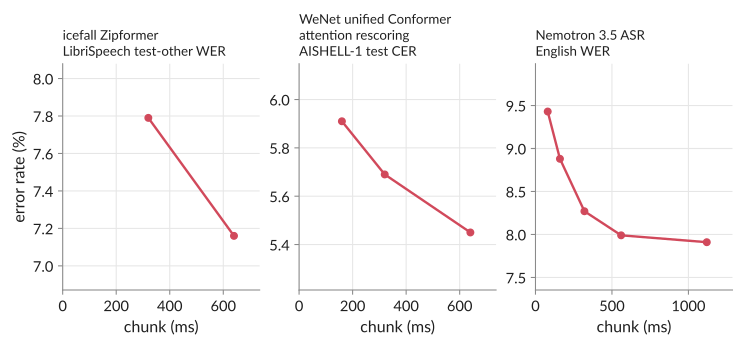
Within each family the shape is the same: accuracy improves as the chunk grows, quickly at first and then slowly. icefall's Zipformer on LibriSpeech test-other goes from 7.79% at 320 ms to 7.16% at 640 ms (greedy, chunk-wise decoding); Nemotron's English WER from 9.43% at 80 ms to 7.99% at 560 ms, and only to 7.91% at 1,120 ms.
Test sets and their licences
The book measures on fixed 200-utterance subsets of LibriSpeech test-clean and test-other (English, CC BY
4.0, openslr.org/12) and AISHELL-1 test (Mandarin, Apache 2.0, openslr.org/33), listed in
code/data/manifests/. Before you publish numbers on other corpora, read their terms: WenetSpeech is
released "for non-commercial purposes" (its official site, although openslr.org/121 lists plain CC BY 4.0);
GigaSpeech's download terms allow "only ... non-commercial research and educational purposes" although
its Hugging Face metadata says apache-2.0; TED-LIUM 3 is CC BY-NC-ND 3.0.
The book's measurements
Both tracks, streamed with the harness at simulated real-time pacing in 160 ms client chunks, scored with
en-lower+punct and zh-full. The CPU track runs sherpa-onnx streaming Zipformers on one thread of an
Intel i5-12600K; the GPU track runs NeMo cache-aware FastConformer and Nemotron 3.5 ASR through the book's
incremental adapter (chapter 5) on one RTX 4090. Every row comes from a result file in
code/ch09_measure/results/ that records its command, package versions, hardware and load.
English, LibriSpeech, 200 utterances per set. Word latency is the time at which a correctly recognized word first appears in a partial result that never changes it again, minus the end of that word in a wav2vec 2.0 forced alignment of the reference; it includes the chunk, the look-ahead, compute and emission delay.
| System | Setting | test-clean WER | test-other WER | First token p50 / p90 (clean) | Word latency p50 / p90 (clean) | UPWR (clean) | RTF (clean) |
|---|---|---|---|---|---|---|---|
| Zipformer, CPU, greedy | 320 ms chunk | 3.18% | 8.08% | 631 / 887 ms | 582 / 742 ms | 0.30 | 0.075 |
| Zipformer, CPU, beam 4 | 320 ms chunk | 3.10% | 7.79% | 631 / 887 ms | 583 / 737 ms | 0.30 | 0.077 |
| FastConformer transducer, GPU | [70,0] |
3.42% | 7.91% | 532 / 755 ms | 419 / 599 ms | 0.42 | 0.122 |
| FastConformer transducer, GPU | [70,1] |
3.15% | 6.92% | 522 / 746 ms | 390 / 551 ms | 0.39 | 0.067 |
| FastConformer transducer, GPU | [70,6] |
2.69% | 5.79% | 715 / 939 ms | 571 / 851 ms | 0.11 | 0.022 |
| FastConformer transducer, GPU | [70,13] |
2.69% | 5.42% | 716 / 939 ms | 751 / 1,251 ms | 0.06 | 0.013 |
| FastConformer CTC, GPU | [70,0] |
4.67% | 9.56% | 627 / 818 ms | 480 / 640 ms | 0.54 | 0.118 |
| FastConformer CTC, GPU | [70,13] |
3.10% | 5.91% | 746 / 1,095 ms | 810 / 1,310 ms | 0.07 | 0.012 |
Mandarin, AISHELL-1 test, 200 utterances, scored with zh-full:
| System | Setting | CER | First token p50 / p90 | UPWR | RTF |
|---|---|---|---|---|---|
| Zipformer, CPU, greedy | 320 ms chunk | 4.55% | 599 / 823 ms | 0.000 | 0.079 |
| Zipformer, CPU, beam 4 | 320 ms chunk | 3.53% | 600 / 763 ms | 0.013 | 0.082 |
| Nemotron 3.5 ASR, GPU | [56,0] |
12.45% | 569 / 698 ms | 0.000 | 0.158 |
| Nemotron 3.5 ASR, GPU | [56,13] |
12.42% | 591 / 723 ms | 0.000 | 0.017 |
The CPU track's Mandarin model was trained on data sets that include some released only for research or non-commercial use; Appendix C has the details.
UPWR here counts mostly a half-shown last word growing ("fain" becoming "faintly"), not rewrites: in every English row except beam search, every unstable unit was of that kind (chapter 6).
Source: code/ch09_measure/results/summary_table.json (python code/ch09_measure/make_tables.py rebuilds it
from the per-run files; the CTC rows at [70,1] and [70,6] and Nemotron at [56,3] and [56,6] are there too).
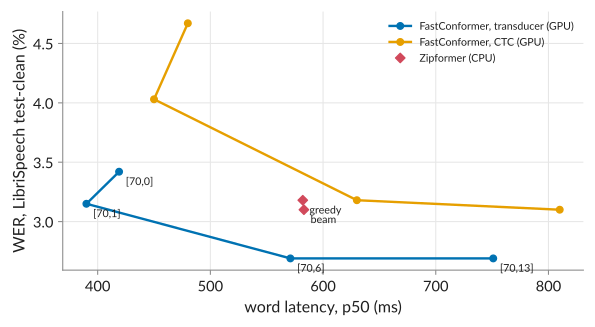
What the tables say, reading only what was measured:
- A word's latency has two parts, and they trade. Split each word's latency into the wait for the audio of
the encoder step that contains its end, and the time after that step until the word appears for good. From
the per-word logs of the transducer runs on test-clean (
code/ch09_measure/breakdowns.py, results incode/ch09_measure/results/breakdowns.json):
| Setting | Chunk | Wait for audio, p50 | After the step, p50 | Words that appear 160 ms or more after the step | Word latency, p50 |
|---|---|---|---|---|---|
[70,0] |
80 ms | 140 ms | 339 ms | 91% | 419 ms |
[70,1] |
160 ms | 140 ms | 171 ms | 88% | 390 ms |
[70,6] |
560 ms | 380 ms | 11 ms | 32% | 571 ms |
[70,13] |
1,120 ms | 620 ms | 11 ms | 15% | 751 ms |
The wait for audio is about half a chunk plus the time to fill the last 160 ms packet, as chunk arithmetic
predicts (chapter 3: inside a chunk the look-ahead runs from the chunk length down to zero). What the
configuration does not show is the second column. With a long chunk the model, having seen the future,
emits each word in the same step. With a short chunk it waits: 88% of words appear 160 ms or more after the
step that contained their end. With less look-ahead the words appear later after the step that contained them, so
cutting the chunk from 1,120 to 160 ms cut the median word latency by 361 ms, not by 480.
- Zero look-ahead was not the fastest. [70,0] and [70,1] wait the same for audio here, because the
harness sends 160 ms packets and [70,0] processes its two 80 ms steps together when a packet arrives. The
difference is all after the step: [70,0] emits later (339 against 171 ms) and spends more compute per packet
(19.3 against 10.5 ms median), for a median word latency of 419 against 390 ms and a higher WER, with both
heads (CTC: 480 against 450 ms). No partial result was ever rewritten in either; the words come out later,
not differently.
- The end of the file helps the long chunk. At [70,13], 259 of 3,997 words (6.5%) became final only when
the end of the file flushed the encoder, so their latency was set by the file's trailing silence rather than by
the next chunk. In a live stream, where audio keeps coming, those words would wait for the next chunk instead.
- Accuracy saturates before latency does. On test-clean, [70,6] and [70,13] have the same WER, 2.69%,
180 ms apart in median word latency.
- RTF is not latency. The GPU track's transducer RTF ranges from 0.013 to 0.122 across settings, and the slowest by
RTF, [70,0], is among the fastest in word latency. At [70,0] the recognizer runs 12.5 steps per second and spends
a median 19.3 ms of compute on each 160 ms packet.
- The CPU track is close behind. The CPU Zipformer's 582 ms median word latency at 3.18% WER is just
behind the FastConformer's [70,6] on both (571 ms, 2.69%), on one CPU thread against a GPU.
- In Mandarin, the GPU track is much weaker. Nemotron 3.5 ASR's CER on AISHELL-1 was 12.4 to 14.0% across
settings against 3.5 to 4.6% for the CPU Zipformer; its model card places Mandarin in a broader-coverage
tier, and in 5 to 12 of the 200 utterances per setting it emitted runs of a Thai character, in the book's adapter; NeMo's own streaming loop produced the same final text on the one utterance of the first ten where the adapter showed it.
Concurrency, many streams at once, is chapter 15's subject.
Common misconceptions
"WER is a percentage of words, so it is at most 100%." It is edits per reference word; insertions make it unbounded.
"WER is WER." Without the normalizer, a WER is not reproducible. Whisper's normalizer, the Open ASR Leaderboard's and jiwer's default give different numbers for the same output.
"A 5.81% streaming CER on AISHELL-1." For WeNet U2++ that is the first, CTC pass; its final result is 5.05%.
Try it
CPU track
bash code/ch09_measure/run_cpu_all.shruns the CPU-track Zipformers on the three test subsets with greedy and modified beam search. Each run writes per-utterance logs under$BOOK_DATA/runs/and a summary JSON.python code/ch09_measure/make_tables.pyrebuilds the summary table from those files.hbasr.evaluate.score(<run directory>/utts.jsonl, "en")rescores a run under every normalizer at once; the result'saccuracyblock holds one entry per normalizer. Try it on your own model's output.
GPU track
code/ch09_measure/run_gpu_all.sh runs the NeMo models at [70,0], [70,1], [70,6] and [70,13] on
one GPU; its header gives the exact command line. Compare the WER with the published card values above, and
the word latency across settings. Do not compare the final latency after end of speech across settings: at the
end of a file the recognizer flushes without waiting for look-ahead, so on test-clean its median is 283 to 286 ms for every setting
(334 to 345 ms on test-other), the files' trailing silence plus the flush.
English and Mandarin
Score the Mandarin run with zh-raw and then zh-full. Find the utterances whose CER changes, and see
which of the five Mandarin choices caused it.
Key terms
- substitution, deletion, insertion (S, D, I): the three edit types of an alignment.
- word error rate (WER): (S + D + I) / reference words; can exceed 100%.
- character error rate (CER): the same over characters; the standard for Mandarin.
- pooled WER: total edits over total reference words for a test set.
- text normalizer: the transformation applied to reference and hypothesis before scoring.
- UPWR, UPSR: unstable partial word ratio and unstable partial segment ratio.
- simulated pacing: replaying audio against a virtual clock instead of sleeping.
- backlog: time between a chunk's arrival and the start of its processing.
Sources
- jiwer v4.0.0 (commit 19e88ea):
src/jiwer/process.py,src/jiwer/transformations.py: https://github.com/jitsi/jiwer/tree/19e88eae1815e7ca40db9b45b14af5f1f9d8b6ce - usnistgov/SCTK (commit 9688a26):
doc/sclite.htm: https://github.com/usnistgov/SCTK/tree/9688a26882a688132a5e414cadcb4c19b6fffaba - Radford et al., "Robust Speech Recognition via Large-Scale Weak Supervision", arXiv:2212.04356; openai/whisper v20250625 (commit 31243ba),
whisper/normalizers/english.py. - huggingface/open_asr_leaderboard (commit 2aaa07a):
normalizer/normalizer.py; "Open ASR Leaderboard: Towards Reproducible and Transparent Multilingual and Long-Form Speech Recognition Evaluation", arXiv:2510.06961. - icefall (commit 9c96676):
icefall/utils.py,egs/librispeech/ASR/RESULTS.md,egs/aishell/ASR/RESULTS.md: https://github.com/k2-fsa/icefall/tree/9c966762e058bd7ba79d9da71e42fc06b64b703e - WeNet (commit be6ad97):
tools/compute-wer.py,tools/compute-cer.py,examples/aishell/s0/README.md: https://github.com/wenet-e2e/wenet/tree/be6ad97fdb512589df113042f7ff3a29d392fb38 - Shangguan et al., "Analyzing the Quality and Stability of a Streaming End-to-End On-Device Speech Recognizer", arXiv:2006.01416.
- nvidia-riva/cpp-clients (commit 3911b0b):
riva/clients/asr/streaming_recognize_client.cc; Riva 2.19.0 ASR performance documentation. - NVIDIA model cards:
nvidia/stt_en_fastconformer_hybrid_large_streaming_multi(revision ae98143),nvidia/nemotron-3.5-asr-streaming-0.6b(revision ea30d66). - openslr.org resources 12 (LibriSpeech), 33 (AISHELL-1), 121 (WenetSpeech); the WenetSpeech official site; the GigaSpeech access terms on Hugging Face.